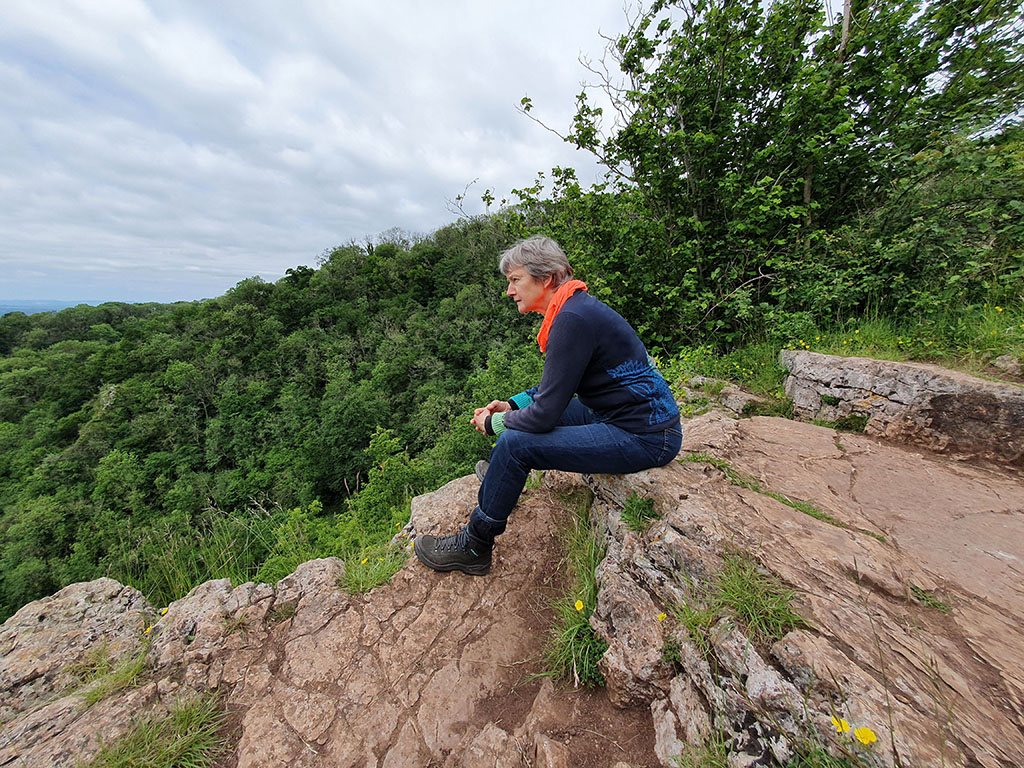
Trees are fascinating. Since my youth, i used to take long walks with my father in the forests o Montferland, the region where I was born.
As a visual artist I work from my studio in Leeuwarden.
In my art, it’s about the offspring, survival and decomposition of trees. I love mature trees, that were given time and space to develop their uniqueness, with whimsical shapes, hollows and fallen branches. I depict them trough painting and textiles.
Another passion is languages. As a professor of French, Spanish and Dutch I worked from 1980 to 2003 at Van Hall Larenstein University in Groningen, and Leeuwarden.
Even as an artist, languages continue to occupy me. I write books, translate and edit texts. Do you like to know more about my activities? Then keep reading, or send me an email.
______________________________________________
Curriculum Vitae Marian Hulshof
Personal
Born: 1951, Zeddam, Montferland (Netherlands)
Visual artist, writer, editor
Studio in Leeuwarden (NL)
Studies
2008 Bachelor of Fine Arts; Academy Minerva Groningen
1989 Management; University of Amsterdam
1981 Master of Communication Sciences and Spanish, Rijks Universiteit Groningen
1972 Bachelor of French and Romanian, Rijks Universiteit Groningen
Exhibitions (selection)
2026 Aken/Eilendorf, Siegfried Linie, 3-11/7
2026 Kunsterf Norg, Wondergronds, 21/6-19/7
2026 MOW, Bellingwolde, Rooted, 17/5-25/10
2025 Church of Ginnum, Lauwersland, Kunst aan huis, 8/9 en 15/16 March 2024-25 Spoonk Art Cantina, Leeuwarden, WNDRLND
2024 Forma Aktua, Groningen, Forma textilia
2023 CEA, Callosa d’en Sarrià, Spain, Hojas de Callosa
2023 Parc Vijversburg, Tytsjerk, duo with Leli Hoch, Trees are Sanctuaries
2022 Forma Aktua Pinakotheek, Groningen
2019 Grateloup-Saint-Gayrand, France, Resurrexit
2019 Rietvlechtschool, Kunstwerk in de Stellingen, Noordwolde, Explosion!
2018 Kanselarij, Leeuwarden (solo), Cultural Capital of Europe
2018 Academie Minerva, Groningen, Allie van Altena Minerva Farewell Exhibition
2018 Maison du Cambodge, Paris, Angkor à Paris (solo)
2016-’17 Aratoi Museum, Masterton, New Zealand, Art is a living thing
2016 Natuurmuseum, Leeuwarden (solo)
2016 Galerie Noord, Groningen, Fabric as a source of inspiration
2015 New Zealand Pacific Studio Incorporated (solo)
2015 Hof ter Saksen, Beveren (B), (duo with Jan Hofman)
2014 It Maskelyn, Hurdegaryp, Inauguration of the art wall (solo)
2013 Oldeberkoop, Open Stal
2013 Schierstins, Veenwouden, Arbor Vitae (solo)
2012 World Trade Center, Leeuwarden (solo)
2012 Appelscha, Drents Friese Wold, Myth of nature
2012 Centre of Fine Arts Drenthe, Assen, Designs Myth of nature
2012 Studio De Werkvloer, Utrecht (duo with Birgitte van Os)
2011 Fraeylemaborg, Slochteren, Gerrit van Houten Award
2011 Gallery Arteria, Dwingelo (duo with Arno van Valburg)
2011 Public Library, Groningen (solo)
2011 Synagogue of Borne, Mysterious Nature (solo)
2011 Ayrspace, Ayr, Ontario, Canada, International Women Celebrate
2011 Gallery BAS, Sneek, Textile and Paint
2010 Museum Belvédère, Heerenveen, NOK
2010 Art café The Dream, Dokkumer Nieuwe Zijlen, Lauwersland (solo)
2010 Social Insurance Bank (SVB), Groningen, Abri (solo)
2009-’10 Frisian Museum – Blokhuispoort, Leeuwarden, The great escape
2009 Art Space Hiemstra, Oldeberkoop, 700 years Stellingwerven
2009 Nicolai & Tabak Hurdegaryp, Trees with character (solo)
2009 De Friesland, Leeuwarden, Growth(solo)
2009 De Lawei, Drachten, Upcoming Talent IV
2009 Pictura, Groningen, 18e Salon de Printemps
2008 Westergasfabriek, Amsterdam, Jong Talent 2008, nomination Artolive Award
Residencies
2023 October/November, Callosa d’ En Sarrià, Spain
2023 Juli, Park Vijversburg, Tytsjerk (NL), Open Studio with Leli Hoch
2019 August/September, Grateloup-Saint-Gayrand (F)
2017 January, NZ Pacific Studio, Mt Bruce Masterton, NZ
2015 December, NZ Pacific Studio, Mt Bruce Masterton, NZ
Awards
2012 Gerrit van Houten Award, short list
2008 ArtOlive Young Talent ’08 Award, short list
Press and Broadcast
2022 Silvijn Stokman, I came into another world. Gelderlander, 28 January
2019 Leli Hoch, Stairway to Heaven, The mount of the ladder. 3 September
2019 G.M., Grateloup-Saint-Gayrand, Des Artistes à la hauteur. Le Républicain, 5 September
2018 Renske Mulder, Rampant Roots. Leeuwarder Courant, 30 November
2018 Monique Peereboom, ‘Producing a painting is exploding’. Rondom Leeuwarden, Issue 14, Vol 182, Nov, p. 25.
2016 Madeleine Slavick, Living things. The Wairarapa Journal Summer 2017. Published on Nov 21, p. 44.
2016 Gitte Brugman, Caressable Trees. Leeuwarder Courant, 29th of July.
2016 Chris Daniell, Wairarapa’s best-kept secret. Wairarapa Lifestyle Magazine, summer 2016. Issue #39, p. 49.
2016 Radio New Zealand, Interview by Teresa Cowie: Sanctuary for Artists in historic Wairarapa homestead. Date: Friday the 15th of January, 8:41u, www.radionz.co.nz click ‘listen’, listen from time unit 04:40 until 7:00.
2013 Susan van den Berg, Painting with fabrics. Leeuwarder Courant, 14th of June
2012 Rianne Kramer, Fifteen ‘myths’ that make revive nature. Friesch Dagblad, 11th of July
2012 Santen, Kirsten van, Humble Art in Great Drents Frisian Wood. Leeuwarder Courant, 28th of July
2010 Sytze Singelsma, NOK shows large top of northern Art: 17th of May.
2010 Marije Bouman, Fourth Edition of NOK is forest of Art: 18th of May.
2010 Omrop Fryslân, K-rûte, Artists Portrait. Date: 10th of January (broadcast).
2009 Marije Blacquière, Rooted in No-man’s-land. Actief, 23th of December.
2009 Ellen Stikkelbroeck, The beauty of trees with character. Friesch Dagblad, 16th of December.
2009 Sytse Singelsma, Upcoming talent in The Gallery. Leeuwarder Courant, 5th of June.
2008 Marja Boonstra, Kissed Awake. Leeuwarder Courant, 18th of Oktober.
2008 André Keikes, Beautiful Degeneration. Leeuwarder Courant, 5th of September.
Books
2022 I want to talk. The life of a straight-backed girl from Avest. Aalten: Fagus Editor. Isbn: 978 90 832037 3 7
2016 Learning to interview. Groningen: Noordhoff Editors. 7th Edition, with website
2015 Marian Hulshof, artist. With text by Olphaert den Otter.
2015 Marian Hulshof and Jan Hofman. Catalogue Hof ter Saksen, Antwerp.
2013 Open Stal. Catalogue. Oldeberkoop.
2013, 2012, 2011 Leeuwarden: Frisian Museum, editor
2012 Myth of Nature. Guide.
2011 Uit de Kunst. Catalogue Jubilee Exhibition. Foundation The Borne Synagogue, 1886-2011.
2011 International Women Celebrate, Ayrspace, Ayr, Ontario, Canada.
2010 Landverwanten. De Marne: Stichting Kunst aan Huis.
2009 Laandschop. Oldeberkoop: Stichting Prop.
2008 Young Talent 2008. Amsterdam: ArtOlive.
2008 Beyond Borders. Groningen: eigen beheer.
2008 Catalogue of Graduation. Groningen: Academy Minerva.
2003 In search of the Pearl. Interviews. Leeuwarden: University Van Hall Larenstein
Collections
Gasterra
SVB Bank
Lecturer and trainer
2017 Workshops at Kingstreet Artworks, Masterton, New Zealand
2015 Lecture at NewZealand Pacific Studios, Masterton, New Zealand.
2012 Several lectures for artists, governors and ecologists as part of the exhibition Myth of Nature
2010 Lecturer at Dokkumer Art Circle, Dokkum (NL)
2009 Guest tutor, Academy Minerva, Groningen (NL)
1980-2003 trainer / tutor, University Van Hall Larenstein, Leeuwarden (NL)
1977-1980 trainer / tutor, Rijks University, Groningen (NL)
1975-1977 trainer / tutor, Tinbergen College, (The Hague), Free School (The Hague) (NL)
Miscelaneous
2023, 2021, 2018, 2016, 2014, 2012, 2010 Jury Culture Award of Tytsjerksteradiel
2015 Curator of the Dutch Society of Sculptors, exposition in Park Vijversburg